Influenza Report
 
Download pdf


第十章:藥物 - 奧斯他偉 (Oseltamivir)

Author(s) 作者:

Bernd Sebastian Kamps and Christian Hoffmann
Translator(s) 譯者: 陳洛志 Chan Lok Chi
Editor (Chinese Version)
編者(中文版本):
韋妙宜Mary M.Y. Waye
  English version


[ back ]

簡介
(綠色連結: 免費全文閱覽)

奧斯他偉(Oseltamivir)是一種有效及有選擇性的�J素抑制劑,能針對抑制流行感冒甲病毒(influenza viruses A)及流行感冒乙病毒(influenza viruses B)中神經胺�J(neuraminidase)的活躍性。神經胺�J(neuraminidase)負責切斷原病毒 (virion)上的唾液酸(sialic acid)或其殘餘物,並且協助散播及擴散病毒原。當病毒原接觸到奧斯他偉(Oseltamivir)後,此藥會使到病毒原聚合在寄主細胞之表面。這些藥物會減低病毒在黏膜分泌物傳播的能力(McNicholl 2001),從而達至降低病毒感染力。

奧斯他偉(Oseltamivir)現在主要用作於預防流行感冒,及治療一般簡單急性感冒徵狀。所謂簡單感冒徵狀是指一歲以上患者染病時間不足二天。H5N1病毒基本對奧斯他偉(Oseltamivir)十分敏感,但從未有資料顯示具有臨床治療效能。

臨床研究顯示,如徵狀出現不足48小時,neuraminidase�J抑制劑能有效減少感冒徵狀之持續時間,例如肌肉酸痛、發熱及頭痛可減少約0.7-1日。臨床效能可達60-70%。如果對於徵狀出現不足30小時之發熱患者,其治療更為有效。另外,在初步實驗奧斯他偉(Oseltamivir)在細胞對病毒感染的免疫反應中,也沒有出現負面作用(Burger 2000)。

另外,有報告指奧斯他偉(Oseltamivir)可能會引致輕微胃腸道不適等負作用(Doucette 2001)。最近,奧斯他偉(Oseltamivir)亦被牽及與幾宗精神失調及兩名日本青年自殺。不過,現在沒有證據指服用奧斯他偉(Oseltamivir)和自殺傾向有因果關係。


化學結構

奧斯他偉(Oseltamivir)是乙基酯類前藥(prodrug),是需要透過酯水解作用轉化成活性形式,奧斯他偉(Oseltamivir)羧基-4-醋胺-5-氨基-3-(1-ethylpropoxy)-1-環乙烷-1-羧基磷酸鹽 (carboxylate[3R,4R,5S]-4-acetamido-5-amino-3-(1-ethylpropoxy)-1-cyclohexene-1-carboxylate phosphate.) 。奧斯他偉(Oseltamivir)藥物設計的發現是利用x光分析類似唾液酸(sialic acid)與流行感冒甲病毒活性區及neuraminidase�J之間聚合結晶體得出啟示 (Lew 2000)。奧斯他偉(Oseltamivir)的製成是透過改變sialic acid類似結構(包括加上嗜油脂鏈lipophilic side chain),目的能夠用於口服(Kim 1998)。有關之化學結構程式如下:
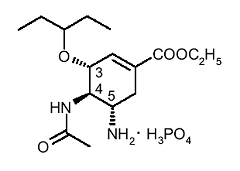
在最初時期,奧斯他偉(Oseltamivir)及其活性代謝物,被稱之為GS4104、Ro 64-0796、GS4071及Ro 64-0802。


藥物代謝動力學

透過口服途徑,奧斯他偉(Oseltamivir)很快會被胃腸道吸收,然後在肝臟轉化為活性奧斯他偉(Oseltamivir)羧基代謝物,最後會分佈全身價,包括上及下呼吸道(Doucette 2001)。如果從上述途徑,當中活性奧斯他偉(Oseltamivir)代謝物的生物效能性可達80%。基本上,30分鐘內就可感察血液中的奧斯他偉(Oseltamivir)代謝物,而其最高濃度是大約3至4小時之後。接�荂A其代謝物濃度以半衰期6至10小時一直退減(He 1999)。

最終血漿排退半衰期,以健康成人為例大約1.8小時。對於患有腎損害之病人來說,代謝物清除率與肌酸酐(creatinine) 清除率是成正比降低,即是約口服藥物後23小時,肌氨酸酐清除率<30毫升/分鐘(Doucette 2001)。故此,應鼓勵病人服用劑量,減少至79毫克每日一次,達至肌氨酸酐清除率<30毫升/分鐘(1.8升/小時)(He 1999)。

漿蛋白黏合為3%。透過腎小球過濾及活性管狀分泌兩大作用,將藥物及其活性代謝物排泄出體外,再沒有繼後新陳代謝進行。化合物既沒有與細胞色素P450混合功能氧化酵素cytochrome P450 mixed-function oxidases或glucuronosyltransferases 產生反應(He 1999)。因此,藥物與藥物相互作用的可能是很低,亦減低了對腎小管外膜細胞負離子輸送型排泄的阻隔。另外,Probenecid阻隔了腎臟排泄奧斯他偉(Oseltamivir)的能力(Hill 2002)。雖然這種情況對奧斯他偉(Oseltamivir)臨床應用上有點不利,但Probenecid或可暫解決奧斯他偉(Oseltamivir)存量短缺問題(Butler 2005)。

患有肝損害的病人未對於奧斯他偉(Oseltamivir)的代謝並沒有危及,不需要調整劑量(Snell 2005)。

對於年老人士方面,活性代謝物在體內的持續時間比年青人高於25%。但不需要調整劑量 (He 1999)。

由於大約1至12歲小童對奧斯他偉(Oseltamivir)代謝率較青年或成人為快, 因此藥物在其體內的時間較短。劑量方面,小童要增加至2毫升/公斤2日一次,才相等於成人的正常劑量(Oo 2001)。大約1歲左右嬰兒亦可以有效地代謝及排泄出奧斯他偉(Oseltamivir)(Oo, 2003)。而對於較年輕兒童來說,服用奧斯他偉(Oseltamivir)時可能有些禁忌(見毒性)。


毒性

最常見的副作用是輕微噁心及嘔吐,多見於服藥後的1-2天出現。

以上不良反應均是奧斯他偉(Oseltamivir)推出市面後所接獲投訴得來。另外,在其他投訴中,亦不知是否與服用奧斯他偉(Oseltamivir)有關。如:

  • 出疹、面部或舌部腫脹、毒性表皮壞死溶解症(toxic epidermal necrolysis, TEN)
  • 肝炎、肝功能出現不正常
  • 心律不齊
  • 抽搐、神志不清
  • 加速糖尿病惡化

服用奧斯他偉(Oseltamivir)應該不會增加出現皮膚反應的機會(Nordstrom 2004)。另外,有些坊間報告指出可能引起特異性皮膚反應,舉例有二位肝硬化病人而進行肝臟切除手術後,服用作為預防藥奧斯他偉(Oseltamivir) 及 zanamivir而出現全身紅疹(Kaji 2005)。鑑於以上事件,食物及藥物管理局(FDA)要求奧斯他偉(Oseltamivir)產品標籤上必定加上「可引起嚴重皮膚/過敏反應」。如果服用者萬一出現嚴重紅疹情況,應立刻停止服用或接觸此藥(FDA 2005)。

1歲以下的兒童不建議服用奧斯他偉(Oseltamivir),因為奧斯他偉(Oseltamivir)對幼鼠進行實驗中出現過中毒反應。另外,如果劑量達1000毫克/公斤奧斯他偉(Oseltamivir)磷酸鹽(大約是兒童建議劑量250倍),會出現大量奧斯他偉(Oseltamivir)磷酸鹽積存於大腦。事實上,兒童對於奧斯他偉(Oseltamivir)磷酸鹽在腦積存之情況是約成人1500倍。而奧斯他偉(Oseltamivir)劑量對於嬰兒的影響就沒有明顯臨床分析。惟恐奧斯他偉(Oseltamivir)對嬰兒的未成熟血腦屏障(blood-brain barrier)有所影響,故一般都不建議讓1歲以下兒童服用此藥。(補充:一般1歲兒童血腦屏障已趨成熟。)

奧斯他偉(Oseltamivir)屬孕婦種類C藥物,所以可能對孕婦及胎兒有一定的影響。有研究顯示,奧斯他偉(Oseltamivir)成份能出現於授乳老鼠的乳液,但就沒有在人體中做過類似實驗,故不能肯定奧斯他偉(Oseltamivir)是否能從人類的乳液中排出。

對於有關病人服用奧斯他偉(Oseltamivir)而出現精神失常之報告,日本當局已將病人出現精神異常反應為服用奧斯他偉(Oseltamivir)之副作用。


功效

治療

奧斯他偉(Oseltamivir)一般用量為75毫克每天2次,為期5天。對於因流感而發燒病人,發病時間不足1.5天的病人,可減少患病時間的1.5天及減輕嚴重度為38% (Treanor 2000)。如果能在發病12小時內,更早接受療程,患病時間更可減少3天。總之,越早接受奧斯他偉(Oseltamivir),越更能減少發燒時間及徵狀嚴重程度和恢復正常的時間 (Aoki 2003)。

一般長期發燒病人,其體?均高於39°C(Kawai 2005)。奧斯他偉(Oseltamivir)藥效大約服後24小時內產生(Nichson 2000)。從包括10個安慰劑對比雙盲試驗中的統合分析meta analysis,發現Oseltamivir可減低患下呼吸道併發症(Kaiser 2003)。

對於患有慢性呼吸器官疾病的患者,包括慢性支氣管炎、阻塞性肺氣腫、支氣管哮喘或支氣管擴張、及慢性心臟病等奧斯他偉(Oseltamivir)的治療功效及安全性則尚未明確。在一些小型隨機測試中,奧斯他偉(Oseltamivir)亦有明顯減低患併發症機會(11% vs 45%),及用抗生素的需要(37% vs 69%) (備註: 前者為接受治療組;後者為對比組) (Lin 2006)。

奧斯他偉(Oseltamivir)治療對流行感冒乙病毒(influenza viruses B)之效能比流行感冒甲病毒(influenza viruses A)為低。(有關對H5N1病毒藥效研究見下文)。

從經濟學角度上,包括考慮流行病學資料及抗病毒藥的臨床試驗,結論是對於一些無疫苗注射及高危疫苗注射病人進行分析。總論是取用奧斯他偉(Oseltamivir)治療是較為符合經濟效益。而其他病人,需等待快速測試結果才開始治療(Rothberg 2003)。


預防

在進行奧斯他偉(Oseltamivir)對患者反應測試中,奧斯他偉(Oseltamivir)之預防力能減少患者數目[8/12 (67%)在安慰劑組及8/21(38%)在奧斯他偉(Oseltamivir)服用組];及減少引起感染性呼吸道疾病(4/12 vs,0/21;p=0.16;效能61%)(Hayden 1999a)。這些數據是從1559健康及無免疫反應的成人(18至65歲)進行了六星期測試得出來。他們分成兩組:奧斯他偉(Oseltamivir)服用組(75毫克或150毫克每日)及安慰劑組(Hayden 1999b)。服用奧斯他偉(Oseltamivir)(1. 2%)一組對患流感機會比起服用安慰劑另一組較低(4.8%)。奧斯他偉(Oseltamivir)的預防流感效果達74%(Hayden 1999b)。用統合分析方法分析七種預防測試中,奧斯他偉(Oseltamivir)之預防流感能力達70至90%(Cooper 2003)。

對於預防家居接觸的流感指標個案(IC),發現奧斯他偉(Oseltamivir)能有效預防流感達89%(Welliver 2001)。在一個隨機測試中,服用安慰劑組有12.6%(26/206)出現流感徵狀,相反服用奧斯他偉(Oseltamivir)組只有1.4%(3/209)。在另一隨機測試中,家居接觸人在有流感指標個案,即出現類似流感徵狀(如體溫高過37.8°C及咳嗽)時則隨機分成兩組:一組讓其進行十天的接觸病毒後預防治療(post-exposure prophylaxis,PEP)另一組則發病後才治療。所有指標個案則接受五天治療(Hayden 2004),奧斯他偉(Oseltamivir)預防治療PEP能有68%預防率。單單對比治療的指標個案,服用安慰劑組有13%(33/258)出現流感徵狀,相反服用奧斯他偉(Oseltamivir)組只有4%(10/244) (p=0017)。

從經濟學角度上,服用奧斯他偉(Oseltamivir)預防流感比起服用amantadine或不作任何預防更符合經濟效益(Risebrough 2005)。但是另外一個近期的統合分析,認為奧斯他偉(Oseltamivir)對於較嚴重的傳染性或流行性的感冒病較有明顯功效,但對於控制季節性感冒病就不太明顯(Jefferson 2006)。


選擇性病人組群

透過雙盲及安慰劑方法,對548虛弱及年老的在家人士(中位數為81歲,多於80%受免疫注射)進行口服奧斯他偉(Oseltamivir)預防流感實驗(Peters 2001)。對比服用安慰劑,奧斯他偉(Oseltamivir)能減低92%人士患流感機會(1/276 = 0.4 % ;12/272 = 4.4 %)。而且奧斯他偉(Oseltamivir)能有效地減低患流感繼後併發症(Peters 2001)。

兒童:兒科病人口服奧斯他偉(Oseltamivir)後,能減少患流感時間至36小時及其他出現徵狀時間(如咳嗽、發燒等)。加上,亦減少的44%患中耳炎機會及服用抗生劑的次數 (Whitley 2001)。在最近研究中,發現奧斯他偉(Oseltamivir)能縮短哮喘兒童出現徵狀時間、改善其肺功能以及減低哮喘惡化機會(51 % 對 68 %) (Johnston 2005)。

至於,奧斯他偉(Oseltamivir)對於慢性心臟疾病及呼吸道疾病的功效仍未確定。另外,無資料顯示,因進行奧斯他偉(Oseltamivir)治療而出現嚴重情況,需送院收容。還有,病人做過骨髓移植手術首六個月後,因疫苗的免疫力太低而採用奧斯他偉(Oseltamivir)作用預防之用(Machado 2004)。


對H5N1禽流感之效能

在試管實驗中,奧斯他偉(Oseltamivir)的確對流行感冒甲及乙病毒(influenza viruses A & B)有一定的抗病毒能力,包括曾一度在香港肆虐的H5N1 及 H9N2病毒(Leneva 2000)。根據WTO資料所得,H5N1禽流感個案已減少(Writing Committee of the WHO 2005)。相反,仍未有實質顯示奧斯他偉(Oseltamivir)能有效減少H5N1病毒感染。最近,更有報告指出即使適當劑量,也不能抑制病毒自我複製,甚至引起抗藥反應(de Jong 2005)。對於此問題,是否應加重劑量或延長治療時間仍在爭論中。另一個討論問題,奧斯他偉(Oseltamivir)能適用於後期病毒已進行複製這個情況。現只得些極有限證據說明後期採用奧斯他偉(Oseltamivir)能減少病毒在體內數量,以及增加病人存活率(de Jong 2005)。這個數據結果,與有關老鼠實驗是一致的。例如進行5天療程的話,實驗老鼠的存活率達50%;進行8天療程的話,實驗老鼠的存活率達80% (Yen 2005b)。另外一個實驗,即使延遲了5天進行療程,其存活率也可由0%升至75% (McCullers 2004)。

較高奧斯他偉(Oseltamivir)劑量也算對人體安全。資料顯示,5天療程150毫克每天二次或6周療程75毫克每天二次作預防之用,也可算是許可之劑量(Ward 2005)。


對1918年流行感冒病毒之效能

這種結合性病毒是由1918 NA或1918 HA及1918 NA兩個方法構成。而奧斯他偉(Oseltamivir)正正能抑制有關在細胞組織培養實驗或老鼠中的結合性病毒。因此,認為奧斯他偉(Oseltamivir)能抑制1918年流行的感冒病毒或其類似的病毒(Tumpey 2002)。


抵抗性

在試管實驗中,NA突變E119V, R292K, H274Y, and R152K會引起對奧斯他偉(Oseltamivir)抗藥性(McKimm-Breschkin 2003)。而病毒有R292K突變的話,其自我複製能力會喪失,及其致病能力在實驗老鼠中比野生型低於10,000倍(Tai 1998)。同樣而言,當有H274Y突變的話,其自我複製能力會減至3度(logs) (Ives 2002),故需多於100倍病毒數量才可使白鼬致病,比野生型傳播力低(Herlocher 2004)。

根據以上所講,病毒出現突變而影響它適應能力的話,根本不需要關注。最近,有些報告質疑H5N1病毒能引起對奧斯他偉(Oseltamivir)高度抗藥性這種講法(Le 2005, de Jong 2005)。雖然即使服用適當奧斯他偉(Oseltamivir)劑量(有病徵之後一天服用),未能抑制病毒自我複製及引起抗藥的病毒,但很難知道真正原因是否由於導致病毒大量複製或重症病人體內的藥理反應已有改變。

反之,季節性H1N1及H3N2流感病毒在成人及年青人中產生對抗因子能力較低,多見於兒童。其一有研究指出,病毒中神經胺�J(neuraminidase)突變為9/50病人(18%)(Kiso 2004) 。而因為兒童是其病毒其中一個傳播媒介,即使五天後接受治療,這些資料也需調查。

在實驗研究中,可發現抗奧斯他偉(Oseltamivir)突變異種及抗Zanamivir突變異種會發生交叉抵抗性(Cross-resistance)。其中兩個受奧斯他偉(Oseltamivir)引起突變(E119V, H274Y and R292K)會在神經胺�J(neuraminidase)同一個胺基酸餘物,出現於其中兩個受Zanamivir引起突變的病毒內(E119G/A/D, R152K and R292K) (Tamiflu 2005)。


藥物相互作用

根據藥理學及藥物動力學研究顯示,藥物治療上出現奧斯他偉(Oseltamivir)與沒有奧斯他偉(Oseltamivir)相互作用 (Tamiflu 2005)。將奧斯他偉(Oseltamivir)(或奧斯他偉(Oseltamivir)羧基)並不是及細胞色素P450的基質或抑制劑。


用法建議

歐盟

奧斯他偉(Oseltamivir)(特敏福Tamiflu?)已受歐盟中央許可。用法說明及劑量均根據美國市場認可。

美國

奧斯他偉(Oseltamivir)用作治療一般簡單急性感冒徵狀。所謂簡單感冒徵狀是指一歲以上患者出現徵狀病時間不足二天。再者,奧斯他偉(Oseltamivir),適用於一歲以上患者預防流感。

一般指定治療劑量,13歲或以上人士為75毫克每天二次,以5天一個療程。如不能吞服膠囊之兒童或成人,可選擇30、45及60毫克口服藥液每天二次。 建議劑量:

體重
5天建議劑量
≤15 公斤(≤ 33 磅)
30毫克每天二次
> 15公斤to 23公斤(> 33 磅至 51 磅)
45毫克每天二次
> 23 公斤to 40 公斤(> 51 磅至 88 磅)
60毫克每天二次
> 40 公斤 (> 88 磅)
75毫克每天二次

8歲以上兒童如能吞服藥物可用75毫克膠囊配方。

預防方面,一般建議劑量75毫克每日一天,為期至少七日。對於一歲或以上兒科病人之口服奧斯他偉(Oseltamivir)劑量為如下:

體重
7天建議劑量
≤15 公斤(≤ 33 磅)
30毫克每天二次
> 15公斤to 23公斤(> 33 磅至 51 磅)
45毫克每天二次
> 23 公斤to 40 公斤(> 51 磅至 88 磅)
60毫克每天二次
> 40 公斤 (> 88 磅)
75毫克每天二次


總結

奧斯他偉(Oseltamivir)是一種,具選擇性神經胺�J抑制劑(neuraminidase inhibitor)。接受治療時間一定要在出現徵狀後48小時內,但最好當然是儘快或在24小時內。一般人對奧斯他偉(Oseltamivir)有耐藥力。

國家當局建議不應將奧斯他偉(Oseltamivir)替代為早期疫苗。

對於H5N1病毒,奧斯他偉(Oseltamivir)之功效、最佳劑量及用藥療程仍有待肯定。


商品名稱:Tamiflu™

75毫克膠囊 (10粒一排) 口服粉劑 (用水調制12毫克/毫升;一般水樽含25毫升懸浮液)。

藥物種類:神經胺�J抑制劑(neuraminidase inhibitor)

服用指引:適用於一般非複雜性急性流感患者(1歲以上),出現徵狀不足兩天。 用作預防流感,一般適用於1歲以上之患者。

標準劑量(用作治療):75毫克每日兩次,為期五天。 兒科患者或吞服障礙之成人患者,可選用口服液劑。劑量建議請參考以上。

標準劑量(用作預防):75毫克每日一次,為期至少七天。 兒科患者或吞服障礙之成人患者,可選用口服液劑。劑量建議請參考以上。

特殊劑量:當患者其血清肌酸酐清除率(serum creatinine clearance)一直介乎10-30毫升/分鐘則服用治療劑量為75毫克每日兩次,為期五天、預防劑量為75毫克隔天或30毫克每天。已不能適用於進行常規血液透析或腹膜透析之末期腎病患者則未有明確的劑量可建議。

藥物動力學:口服奧斯他偉(Oseltamivir)一般在胃腸道吸收,然後轉化成奧斯他偉(Oseltamivir)羧基(carboxylate)。最後,奧斯他偉(Oseltamivir)羧基透過尿液排出體外,一般半衰期(half-life)為6-10小時。

禁忌:奧斯他偉(Oseltamivir)不適用於1歲以下之流感患者。除非此藥對孕婦的利益合理地高於可能危害胎兒的風險否則不適用(屬孕婦種類C藥物)。

藥物相互作用:未有明顯的藥物相互作用。

副作用:一般副作用溫和或中度的,如惡心及嘔吐,多見於服藥首兩天。

叮囑:當出現流感徵狀後,患者應盡早服用藥物。同樣應在接觸病毒但未感染前,服用藥物作預防。

小吃後服藥可減輕短暫性腸道紊亂。

對老年患者不需調整劑量。

同一時間進食及服藥,不會對藥物在血中最高濃度及AUC有影響。

藥物貯存於陰涼地方(約25°C或77° F),短暫貯放亦可於15° to 30° C (59° to 86° F)。

奧斯他偉(Oseltamivir)口服液劑,最好由藥劑師調制後配發給病人。

貯存口服液劑,溫度約2° to 8° C (36° to 46° F),不可冰藏。

奧斯他偉(Oseltamivir)不可代替流感疫苗,患者應跟隨國家當局指引接受每年流感疫苗。


互聯網資料

歐洲: http://influenzareport.com/link.php?id=14

美國: http://influenzareport.com/link.php?id=1


參考

  1. Aoki FY, Macleod MD, Paggiaro P, et al. Early administration of oral oseltamivir increases the benefits of influenza treatment. J Antimicrob Chemother 2003; 51: 123-9. Abstract: http://amedeo.com/lit.php?id=12493796 - Full text at http://jac.oxfordjournals.org/cgi/content/full/51/1/123
  2. Burger RA, Billingsley JL, Huffman JH, Bailey KW, Kim CU, Sidwell RW. Immunological effects of the orally administered neuraminidase inhibitor oseltamivir in influenza virus-infected and uninfected mice. Immunopharmacology 2000; 47: 45-52. Abstract: http://amedeo.com/lit.php?id=10708809
  3. Butler D. Wartime tactic doubles power of scarce bird-flu drug. Nature 2005; 438: 6.
  4. Calfee DP, Hayden FG. New approaches to influenza chemotherapy. Neuraminidase inhibitors. Drugs 1998; 56: 537-53. Abstract: http://amedeo.com/lit.php?id=9806102
  5. Carr J, Ives J, Kelly L, et al. Influenza virus carrying neuraminidase with reduced sensitivity to oseltamivir carboxylate has altered properties in vitro and is compromised for infectivity and replicative ability in vivo. Antiviral Res 2002; 54: 79-88. Abstract: http://amedeo.com/lit.php?id=12062393
  6. Centers for Disease Control. Neuraminidase inhibitors for treatment of influenza A and B infections. MMWR Recomm Rep 1999; 48: 1-9. Abstract: http://amedeo.com/lit.php?id=10632443 - Full text at http://www.cdc.gov/mmwr/preview/mmwrhtml/rr4814a1.htm
  7. Chokephaibulkit K, Uiprasertkul M, Puthavathana P, et al. A child with avian influenza A (H5N1) infection. Pediatr Infect Dis J 2005; 24: 162-6. Abstract: http://amedeo.com/lit.php?id=15702046
  8. Cooper NJ, Sutton AJ, Abrams KR, Wailoo A, Turner D, Nicholson KG. Effectiveness of neuraminidase inhibitors in treatment and prevention of influenza A and B: systematic review and meta-analyses of randomised controlled trials. BMJ 2003; 326: 1235. Abstract: http://amedeo.com/lit.php?id=12791735 - Full text at http://bmj.bmjjournals.com/cgi/content/full/326/7401/1235
  9. de Jong MD, Tran TT, Truong HK, et al. Oseltamivir resistance during treatment of influenza A (H5N1) infection. N Engl J Med 2005; 353: 2667-72. Abstract: http://amedeo.com/lit.php?id=16371632 - Full text at http://content.nejm.org/cgi/content/full/353/25/2667
  10. Doucette KE, Aoki FY. Oseltamivir: a clinical and pharmacological perspective. Expert Opin Pharmacother 2001; 2: 1671-83. Abstract: http://amedeo.com/lit.php?id=11825310
  11. Dreitlein WB, Maratos J, Brocavich J. Zanamivir and oseltamivir: two new options for the treatment and prevention of influenza. Clin Ther 2001; 23: 327-55. Abstract: http://amedeo.com/lit.php?id=11318072
  12. Dutkowski R, Thakrar B, Froehlich E, Suter P, Oo C, Ward P. Safety and pharmacology of oseltamivir in clinical use. Drug Saf 2003; 26: 787-801. Abstract: http://amedeo.com/lit.php?id=12908848
  13. FDA - Food & Drug Administration. FDA Approves Tamiflu for Prevention of Influenza in Children Under Age 12. Accessed on 8 January 2006 from http://www.fda.gov/bbs/topics/news/2005/NEW01285.html
  14. Gubareva LV, Kaiser L, Hayden FG. Influenza virus neuraminidase inhibitors. Lancet 2000; 355: 827-35. Abstract: http://amedeo.com/lit.php?id=10711940
  15. Gubareva LV, Kaiser L, Matrosovich MN, Soo-Hoo Y, Hayden FG. Selection of influenza virus mutants in experimentally infected volunteers treated with oseltamivir. J Infect Dis 2001; 183: 523-31. Epub 2001 Jan 11. Abstract: http://amedeo.com/lit.php?id=11170976 - Full text at http://www.jour nals.uchicago.edu/JID/journal/issues/v183n4/000943/000943.html
  16. Hayden FG, Treanor JJ, Fritz RS, et al. Use of the oral neuraminidase inhibitor oseltamivir in experimental human influenza: randomized controlled trials for prevention and treatment. JAMA 1999a; 282: 1240-6. Abstract: http://amedeo.com/lit.php?id=10517426 - Full text at http://jama.ama-assn.org/cgi/content/full/282/13/1240
  17. Hayden FG, Atmar RL, Schilling M, et al. Use of the selective oral neuraminidase inhibitor oseltamivir to prevent influenza. N Engl J Med 1999b; 341: 1336-43. Abstract: http://amedeo.com/lit.php?id=10536125 - http://content.nejm.org/cgi/content/full/341/18/1336
  18. Hayden FG, Jennings L, Robson R, et al. Oral oseltamivir in human experimental influenza B infection. Antivir Ther 2000; 5: 205-13. Abstract: http://amedeo.com/lit.php?id=11075941
  19. Hayden FG, Belshe R, Villanueva C, et al. Management of influenza in households: a prospective, randomized comparison of oseltamivir treatment with or without postexposure prophylaxis. J Infect Dis 2004; 189: 440-9. Abstract: http://amedeo.com/lit.php?id=14745701 - Full text at http://www.journals.uchicago.edu/JID/journal/issues/v189n3/31422/31422.html
  20. He G, Massarella J, Ward P. Clinical pharmacokinetics of the prodrug oseltamivir and its active metabolite Ro 64-0802. Clin Pharmacokinet 1999; 37: 471-84. Abstract: http://amedeo.com/lit.php?id=10628898
  21. Herlocher ML, Truscon R, Elias S, et al. Influenza viruses resistant to the antiviral drug oseltamivir: transmission studies in ferrets. J Infect Dis 2004; 190: 1627-30. Abstract: http://amedeo.com/lit.php?id=15478068
  22. Hill G, Cihlar T, Oo C, et al. The anti-influenza drug oseltamivir exhibits low potential to induce pharmacokinetic drug interactions via renal secretion-correlation of in vivo and in vitro studies. Drug Metab Dispos 2002; 30: 13-9. Abstract: http://amedeo.com/lit.php?id=11744606 - Full text at http://dmd.aspetjournals.org/cgi/content/full/30/1/13
  23. Hurt AC, Barr IG, Durrant CJ, Shaw RP, Sjogren HM, Hampson AW. Surveillance for neuraminidase inhibitor resistance in human influenza viruses from Australia. Commun Dis Intell 2003; 27: 542-7. Abstract: http://amedeo.com/lit.php?id=15508516
  24. Hurt AC, Barr IG, Hartel G, Hampson AW. Susceptibility of human influenza viruses from Australasia and South East Asia to the neuraminidase inhibitors zanamivir and oseltamivir. Antiviral Res 2004; 62: 37-45. Abstract: http://amedeo.com/lit.php?id=15026200
  25. Ives JA, Carr JA, Mendel DB, et al. The H274Y mutation in the influenza A/H1N1 neuraminidase active site following oseltamivir phosphate treatment leave virus severely compromised both in vitro and in vivo. Antiviral Res 2002; 55: 307-17. Abstract: http://amedeo.com/lit.php?id=12103431
  26. Johnston SL, Ferrero F, Garcia ML, Dutkowski R. Oral oseltamivir improves pulmonary function and reduces exacerbation frequency for influenza-infected children with asthma. Pediatr Infect Dis J 2005; 24: 225-32. Abstract: http://amedeo.com/lit.php?id=15750458
  27. Kaiser L, Wat C, Mills T, Mahoney P, Ward P, Hayden F. Impact of oseltamivir treatment on influenza-related lower respiratory tract complications and hospitalizations. Arch Intern Med 2003; 163: 1667-72. Abstract: http://amedeo.com/lit.php?id=12885681 - Full text at http://archinte.ama-assn.org/cgi/content/full/163/14/1667
  28. Kaji M, Fukuda T, Tanaka M, Aizawa H. A side effect of neuraminidase inhibitor in a patient with liver cirrhosis. J Infect Chemother 2005; 11: 41-3. Abstract: http://amedeo.com/lit.php?id=15729487
  29. Kawai N, Ikematsu H, Iwaki N, et al. Factors influencing the effectiveness of oseltamivir and amantadine for the treatment of influenza: a multicenter study from Japan of the 2002-2003 influenza season. Clin Infect Dis 2005; 40: 1309-16. Epub 2005 Mar 16. Abstract: http://amedeo.com/lit.php?id=15825034
  30. Kemink SA, Fouchier RA, Rozendaal FW, et al. A fatal infection due to avian influenza-A (H7N7) virus and adjustment of the preventive measures. Ned Tijdschr Geneeskd 2004; 148: 2190-4. Abstract: http://amedeo.com/lit.php?id=15559415
  31. Kim CU, Lew W, Williams MA, et al. Structure-activity relationship studies of novel carbocyclic influenza neuraminidase inhibitors. J Med Chem 1998; 41: 2451-60. Abstract: http://amedeo.com/lit.php?id=9651151
  32. Kim CU, Chen X, Mendel DB. Neuraminidase inhibitors as anti-influenza virus agents. Antivir Chem Chemother 1999; 10: 141-54. Abstract: http://amedeo.com/lit.php?id=10480735
  33. Kirkbride HA, Watson J. Review of the use of neuraminidase inhibitors for prophylaxis of influenza. Commun Dis Public Health 2003; 6: 123-7. Abstract: http://amedeo.com/lit.php?id=12889291
  34. Kiso M, Mitamura K, Sakai-Tagawa Y, et al. Resistant influenza A viruses in children treated with oseltamivir: descriptive study. Lancet 2004; 364: 759-65. Abstract: http://amedeo.com/lit.php?id=15337401
  35. Koopmans M, Wilbrink B, Conyn M, et al. Transmission of H7N7 avian influenza A virus to human beings during a large outbreak in commercial poultry farms in the Netherlands. Lancet 2004; 363: 587-93. Abstract: http://amedeo.com/lit.php?id=14987882
  36. Le QM, Kiso M, Someya K, et al. Avian flu: isolation of drug-resistant H5N1 virus. Nature 2005; 437: 1108. Abstract: http://amedeo.com/lit.php?id=16228009
  37. Leneva IA, Roberts N, Govorkova EA, Goloubeva OG, Webster RG. The neuraminidase inhibitor GS4104 (oseltamivir phosphate) is efficacious against A/Hong Kong/156/97 (H5N1) and A/Hong Kong/1074/99 (H9N2) influenza viruses. Antiviral Res 2000; 48: 101-15. Abstract: http://amedeo.com/lit.php?id=11114412
  38. Lew W, Chen X, Kim CU. Discovery and development of GS 4104 (oseltamivir): an orally active influenza neuraminidase inhibitor. Curr Med Chem 2000; 7: 663-72. Abstract: http://amedeo.com/lit.php?id=10702632
  39. Lin JT, Yu XZ, Cui DJ, et al. A multicentre, randomized, controlled trial of oseltamivir in the treatment of influenza in a high-risk Chinese population. Curr Med Res Opin 2006; 22: 75-82. Abstract: http://amedeo.com/lit.php?id=16393433
  40. Machado CM, Boas LS, Mendes AV, et al. Use of Oseltamivir to control influenza complications after bone marrow transplantation. Bone Marrow Transplant 2004; 34: 111-4. Abstract: http://amedeo.com/lit.php?id=15094755
  41. Massarella JW, He GZ, Dorr A, Nieforth K, Ward P, Brown A. The pharmacokinetics and tolerability of the oral neuraminidase inhibitor oseltamivir (Ro 64-0796/GS4104) in healthy adult and elderly volunteers. J Clin Pharmacol 2000; 40: 836-43. Abstract: http://amedeo.com/lit.php?id=10934667
  42. McClellan K, Perry CM. Oseltamivir: a review of its use in influenza. Drugs 2001; 61: 263-83. Abstract: http://amedeo.com/lit.php?id=11270942
  43. McCullers JA. Effect of antiviral treatment on the outcome of secondary bacterial pneumonia after influenza. J Infect Dis 2004; 190: 519-26. Epub 2004 Jun 30. Abstract: http://amedeo.com/lit.php?id=15243927 - Full text at http://www.journa ls.uchicago.edu/JID/journal/issues/v190n3/32166/32166.html
  44. McGeer AJ, Lee W, Loeb M, et al. Adverse effects of amantadine and oseltamivir used during respiratory outbreaks in a center for developmentally disabled adults. Infect Control Hosp Epidemiol 2004; 25: 955-61. Abstract: http://amedeo.com/lit.php?id=15566030
  45. McKimm-Breschkin J, Trivedi T, Hampson A, et al. Neuraminidase sequence analysis and susceptibilities of influenza virus clinical isolates to zanamivir and oseltamivir. Antimicrob Agents Chemother 2003; 47: 2264-72. Abstract: http://amedeo.com/lit.php?id=12821478 - Full text at http://aac.asm.org/cgi/content/full/47/7/2264?pmid=12821478
  46. McNicholl IR, McNicholl JJ. Neuraminidase inhibitors: zanamivir and oseltamivir. Ann Pharmacother 2001; 35: 57-70. Abstract: http://amedeo.com/lit.php?id=11197587
  47. Nicholson KG, Aoki FY, Osterhaus AD, et al. Efficacy and safety of oseltamivir in treatment of acute influenza: a randomised controlled trial. Neuraminidase Inhibitor Flu Treatment Investigator Group. Lancet 2000; 355: 1845-50. Abstract: http://amedeo.com/lit.php?id=10866439
  48. Nordstrom BL, Oh K, Sacks ST, L'Italien GJ. Skin reactions in patients with influenza treated with oseltamivir: a retrospective cohort study. Antivir Ther 2004; 9: 187-95. Abstract: http://amedeo.com/lit.php?id=15134180
  49. Oo C, Barrett J, Hill G, et al. Pharmacokinetics and dosage recommendations for an oseltamivir oral suspension for the treatment of influenza in children. Paediatr Drugs 2001; 3: 229-36. Abstract: http://amedeo.com/lit.php?id=11310719
  50. Oo C, Barrett J, Dorr A, Liu B, Ward P. Lack of pharmacokinetic interaction between the oral anti-influenza prodrug oseltamivir and aspirin. Antimicrob Agents Chemother 2002; 46: 1993-5. Abstract: http://amedeo.com/lit.php?id=12019123 - Full text at http://aac.asm.org/cgi/content/full/46/6/1993?pmid=12019123
  51. Oo C, Hill G, Dorr A, Liu B, Boellner S, Ward P. Pharmacokinetics of anti-influenza prodrug oseltamivir in children aged 1-5 years. Eur J Clin Pharmacol 2003; 59: 411-5. Abstract: http://amedeo.com/lit.php?id=12910331
  52. Peters PH Jr, Gravenstein S, Norwood P, et al. Long-term use of oseltamivir for the prophylaxis of influenza in a vaccinated frail older population. J Am Geriatr Soc 2001; 49: 1025-31. Abstract: http://amedeo.com/lit.php?id=11555062
  53. Risebrough NA, Bowles SK, Simor AE, McGeer A, Oh PI. Economic evaluation of oseltamivir phosphate for postexposure prophylaxis of influenza in long-term care facilities. J Am Geriatr Soc 2005; 53: 444-51. Abstract: http://amedeo.com/lit.php?id=15743287
  54. Rothberg MB, Bellantonio S, Rose DN. Management of influenza in adults older than 65 years of age: cost-effectiveness of rapid testing and antiviral therapy. Ann Intern Med 2003; 139: 321-9. Abstract: http://amedeo.com/lit.php?id=12965940 - Full text at http://www.annals.org/cgi/reprint/139/5_Part_1/321.pdf
  55. Sander B, Gyldmark M, Hayden FG, Morris J, Mueller E, Bergemann R. Influenza treatment with neuraminidase inhibitors Cost-effectiveness and cost-utility in healthy adults in the United Kingdom. Eur J Health Econ 2005; 6: 244-52. Abstract: http://amedeo.com/lit.php?id=15875227
  56. Sato M, Hosoya M, Kato K, Suzuki H. Viral shedding in children with influenza virus infections treated with neuraminidase inhibitors. Pediatr Infect Dis J 2005; 24: 931-2. Abstract: http://amedeo.com/lit.php?id=16220098
  57. Schmidt AC. Antiviral therapy for influenza : a clinical and economic comparative review. Drugs 2004; 64: 2031-46. Abstract: http://amedeo.com/lit.php?id=15341496
  58. Shijubo N, Yamada G, Takahashi M, Tokunoh T, Suzuki T, Abe S. Experience with oseltamivir in the control of nursing home influenza A outbreak. Intern Med 2002; 41: 366-70. Abstract: http://amedeo.com/lit.php?id=12058885
  59. Snell P, Dave N, Wilson K, et al. Lack of effect of moderate hepatic impairment on the pharmacokinetics of oral oseltamivir and its metabolite oseltamivir carboxylate. Br J Clin Pharmacol 2005; 59: 598-601. Abstract: http://amedeo.com/lit.php?id=15842560
  60. Stiver G. The treatment of influenza with antiviral drugs. CMAJ 2003; 168: 49-56. Abstract: http://amedeo.com/lit.php?id=12515786 - Full text at http://www.cmaj.ca/cgi/content/full/168/1/49
  61. Tai CY, Escarpe PA, Sidwell RW, et al. Characterization of human influenza virus variants selected in vitro in the presence of the neuraminidase inhibitor GS 4071. Antimicrob Agents Chemother 1998; 42: 3234-41. Abstract: http://amedeo.com/lit.php?id=9835519 - Full text at http://aac.asm.org/cgi/content/full/42/12/3234?pmid=9835519
  62. Takahashi K, Furuta Y, Fukuda Y, et al. In vitro and in vivo activities of T-705 and oseltamivir against influenza virus. Antivir Chem Chemother 2003; 14: 235-41. Abstract: http://amedeo.com/lit.php?id=14694986
  63. Tamiflu (package insert). Gilead Sciences, Foster City, 2005. Accessed on 8 January 2005 from http://www.rocheusa.com/products/tamiflu/pi.pdf
  64. Treanor JJ, Hayden FG, Vrooman PS, et al. Efficacy and safety of the oral neuraminidase inhibitor oseltamivir in treating acute influenza: a randomized controlled trial. JAMA 2000; 283: 1016-24. Abstract: http://amedeo.com/lit.php?id=10697061 - Full text at http://jama.ama-assn.org/cgi/content/full/283/8/1016
  65. Tumpey TM, Garcia-Sastre A, Mikulasova A, et al. Existing antivirals are effective against influenza viruses with genes from the 1918 pandemic virus. Proc Natl Acad Sci U S A 2002; 99: 13849-54. Abstract: http://amedeo.com/lit.php?id=12368467 - Full text at http://www.pnas.org/cgi/content/full/99/21/13849
  66. Ward P, Small I, Smith J, Suter P, Dutkowski R. Oseltamivir (Tamiflu) and its potential for use in the event of an influenza pandemic. J Antimicrob Chemother 2005; 55: Suppl 1: Abstract: http://amedeo.com/lit.php?id=15709056
  67. Welliver R, Monto AS, Carewicz O, et al. Effectiveness of oseltamivir in preventing influenza in household contacts: a randomized controlled trial. JAMA 2001; 285: 748-54. Abstract: http://amedeo.com/lit.php?id=11176912 - Full text at http://jama.ama-assn.org/cgi/content/full/285/6/748
  68. Whitley RJ, Hayden FG, Reisinger KS, et al. Oral oseltamivir treatment of influenza in children. Pediatr Infect Dis J 2001; 20: 127-33. Abstract: http://amedeo.com/lit.php?id=11224828
  69. Writing Committee of the World Health Organization (WHO) Consultation on Human Influenza A/H5. Avian influenza A (H5N1) infection in humans. N Engl J Med 2005; 353: 1374-85. http://amedeo.com/lit.php?id=16192482 - Full text at http://content.nejm.org/cgi/content/extract/353/13/1374
  70. Woodhead M, Lavanchy D, Johnston S, Colman P, Fleming D. Neuraminidase inhibitors: progress in the management of influenza. Int J Clin Pract 2000; 54: 604-10. Abstract: http://amedeo.com/lit.php?id=11220989
  71. Yen HL, Herlocher LM, Hoffmann E, et al. Neuraminidase inhibitor-resistant influenza viruses may differ substantially in fitness and transmissibility. Antimicrob Agents Chemother 2005; 49: 4075-84. Abstract: http://amedeo.com/lit.php?id=16189083
  72. Yen HL, Monto AS, Webster RG, Govorkova EA. Virulence may determine the necessary duration and dosage of oseltamivir treatment for highly pathogenic A/Vietnam/1203/04 influenza virus in mice. J Infect Dis 2005; 192: 665-72. Abstract: http://amedeo.com/lit.php?id=1602813


Department of Biochemistry, The Chinese University of Hong Kong © 2006
